
Concremate Expanding Cement EARL'S
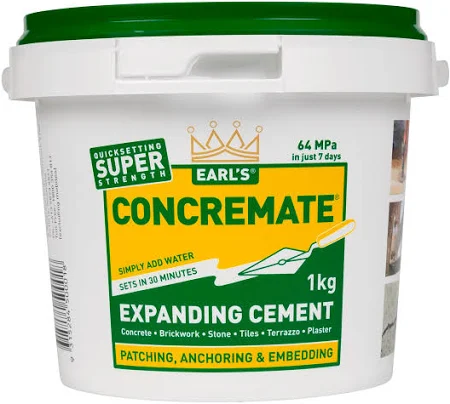
Earl’s Concremate Expanding Cement is a rapid-setting cement for patching holes and cracks or anchoring fixtures into concrete, brick, stone, tile, plaster and terrazzo. Its controlled expansion offsets drying shrinkage, helping the cured material grip the surrounding substrate and embedded item.
- Available sizes: 1kg, 4kg and 10kg
- Working time: approximately 10 minutes at 20°C
- Trafficable / load time: approximately 1 hour at 20°C
- Compressive strength: 20 MPa at 1 hour; 70 MPa at 24 hours
- Two consistencies: trowellable for walls and ceilings or pourable for floors and anchoring
Free Standard Delivery
ORDERS $299+
All products qualify across standard delivery zones.
Your available delivery options and final freight cost are confirmed at checkout.
Australia-Wide Delivery
Metro, regional and interstate delivery options are shown before payment based on your postcode and order contents.
Real Product Advice
Contact our Melbourne team before or after purchase for practical help with product selection, quantities and application.
Secure Checkout
Review your products, delivery cost and complete order total before securely submitting payment.
Homeowners & Trade Welcome
Whether it is one home project or ongoing professional work, we can help you order the right products and quantities.
| Brand: Earl's |
Earl's
Selected by Sealix for reliable performance, practical application and proven results.
Earl’s Concremate Expanding Cement is a fast-setting cementitious compound for patching, embedding and anchoring. Unlike conventional repair mortars that can shrink as they dry, Concremate contains an expanding element that offsets drying shrinkage and helps the material lock into the prepared void.
Use it to repair holes and cracks or embed handrails, bolts, brackets, hooks, signs, awnings and other fixtures in concrete, brickwork, stone, tile, plaster and terrazzo. It can be mixed to a plastic, putty-like consistency for trowelling or a fluid consistency for pouring.
- Controlled expansion helps grip the surrounding substrate and embedded item
- Approximately 10 minutes working time at 20°C
- Sets in approximately 30 minutes and is trafficable after approximately 1 hour at 20°C
- 20 MPa compressive strength at 1 hour and 70 MPa at 24 hours
- Suitable for patching floors, walls and ceilings
- Suitable for anchoring fixtures in concrete and masonry
- Can be mixed as a trowellable or pourable compound
- Can also be used as a high-pressure grout where appropriate
- Concrete and brickwork
- Stone and terrazzo
- Tiles and plaster
- Repairing holes and cracks in floors, walls and ceilings
- Anchoring bolts, threaded rods, brackets, hooks and handrails
- Embedding signs, awnings, machinery fixings and other fixtures
Place only the amount that can be applied within approximately 10 minutes into a clean container. Gradually add clean water and mix until the required consistency is reached. Do not add cement, sand or other substances.
- Trowellable: approx. 300ml water
- Pourable: approx. 400ml water
- Yield: approx. 0.67L trowellable or 0.77L pourable
- Trowellable: approx. 1.2L water
- Pourable: approx. 1.6L water
- Yield: approx. 2.68L trowellable or 3.08L pourable
- Trowellable: approx. 3L water
- Pourable: approx. 4L water
- Yield: approx. 6.7L trowellable or 7.7L pourable
Trowellable consistency: Mix to a firm, putty-like consistency for patching walls and ceilings.
Pourable consistency: Mix to a thick, pancake-batter consistency for floors or pouring around embedded items.
- Drill or prepare the anchoring hole.
- Remove dust and loose cuttings.
- Wet and scrub the internal surfaces, then remove excess water so the hole remains damp without pooled water.
- For floor anchors, position the item and pour fluid Concremate around it.
- For walls or ceilings, press or tamp the item into a plastic-consistency mix.
- Support the embedded item until the material has set—approximately 30 minutes.
- Do not place strain on the embedded item for at least one hour.
- Remove all loose, fractured or contaminated material.
- Chisel the repair edges so no part of the patch is less than 12mm deep. Avoid feather edges.
- Remove dust, dirt and grease.
- Dampen the void and surrounding substrate without leaving standing water.
- Scrub a small amount of mixed Concremate into the internal surfaces to promote contact.
- Use pourable consistency on floors and trowellable consistency on walls or ceilings.
- Smooth with a trowel after approximately 10 minutes.
- After approximately 30 minutes, lightly sprinkle the patch with water. Normal traffic may resume after approximately one hour at 20°C.
- Working time: approximately 10 minutes at 20°C
- Wet density: approximately 1900kg/m³ trowellable; 1800kg/m³ pourable
- Setting expansion: approximately 0.2%
- Net expansion after drying: approximately 0.125% (1/8%)
- Compressive strength: 20 MPa at 1 hour; 70 MPa at 24 hours
- Trafficable: approximately 1 hour at 20°C
- The repair must have room to expand during drying.
- Temperature and site conditions affect working and setting times.
- Mix only what can be placed within approximately 10 minutes.
- Do not retemper the mix after setting begins.
- Wear gloves, eye protection and suitable respiratory protection when handling cement powder.
- For safety-critical or engineered anchoring, confirm the required design, embedment and load capacity with a qualified engineer.
Why SEALIX recommends it: Earl’s Concremate is a useful repair product when ordinary cement shrinkage could loosen a patch or fixing. Its controlled expansion makes it particularly suitable for anchoring, embedding and tightly filling prepared holes, cracks and voids.
- Best for: anchoring bolts or posts, embedding fittings and repairing sound concrete or masonry where a firm mechanical grip is important.
- Mix selection: use a firm trowellable consistency for patching and a pourable consistency for filling around embedded items. Follow the water ratio for the selected pack and application.
- Working advice: prepare everything before mixing, make manageable batches and place the material promptly because it sets quickly. Never add extra water after setting begins.
- Important: it is a cementitious repair and anchoring compound, not a flexible sealant. Moving cracks or structurally unstable substrates require a different repair assessment.